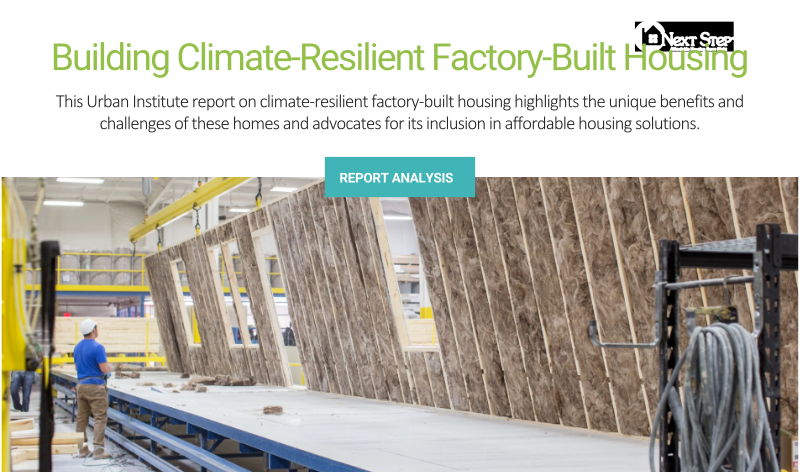
As the nation grapples with an affordable housing crisis and an increasing number of climate-related disasters, factory-built homes must be at the forefront of policy discussions and community development efforts. A recent Urban Institute report on climate-resilient factory-built housing highlights the unique benefits and challenges of factory-built homes, making a compelling case for their inclusion in affordable housing solutions that prioritize long-term sustainability and resilience. Key findings from the report include:
Factory-Built Housing is a Vital Yet Overlooked Component of Affordable & Climate-Resilient Housing
- Factory-built homes provide housing for approximately 18 million Americans, yet they remain largely invisible in federal and local housing policy discussions.
- The HUD code ensures quality and durability, allowing these homes to be built more efficiently and cost-effectively than traditional site-built housing.
- Despite their affordability and efficiency, restrictive zoning laws and outdated perceptions continue to limit the expansion of factory-built housing in many communities.
- Climate resilience must be an integral part of the discussion, ensuring that factory-built homes can withstand extreme weather events and contribute to sustainable development.
Factory-Built Homes Can Be a Key Solution to the Housing Supply & Climate Resilience Crisis
- Factory-built homes are significantly more affordable than site-built homes, often costing between 35% to 73% less per square foot.
- The streamlined production process dramatically reduces construction time—on average, 31.5 days for a factory-built home versus 321 days for a site-built home.
- New federal regulations now allow the production of factory-built duplexes, triplexes, and quadplexes, making these homes viable for urban infill projects.
- Climate-conscious design, including energy-efficient materials and construction techniques, can ensure that factory-built homes contribute to the creation of resilient communities prepared for future climate challenges.
Climate Resilience Must Be a Priority for Factory-Built Housing
- Factory-built housing is often placed in areas vulnerable to climate hazards such as hurricanes, floods, and wildfires.
- Older, pre-1976 mobile homes are particularly susceptible to damage due to outdated construction standards.
- There is an urgent need for investments in retrofitting and upgrading existing factory-built homes to improve resilience.
- Future development must incorporate strategies to mitigate climate risks, such as elevated foundations, reinforced structures, and improved insulation.
Federal & Local Policies Must Support Factory-Built Housing Integration for Climate-Resilient Development
- Policymakers should remove regulatory barriers, such as zoning restrictions that relegate factory-built homes to less desirable locations.
- Federal agencies should invest in research and data collection to better understand the role of factory-built homes in climate resilience.
- Cross-agency collaboration, including FEMA, HUD, and the USDA, could drive policies that incorporate factory-built homes into disaster recovery and mitigation strategies.
- Incentives should be provided for sustainable infrastructure and energy-efficient designs to ensure the long-term viability of factory-built housing in the face of climate change.